Nobody Stopped You, Yet a Challan Arrived. Here Is How Cameras Really Issue Them.
October 18, 2026
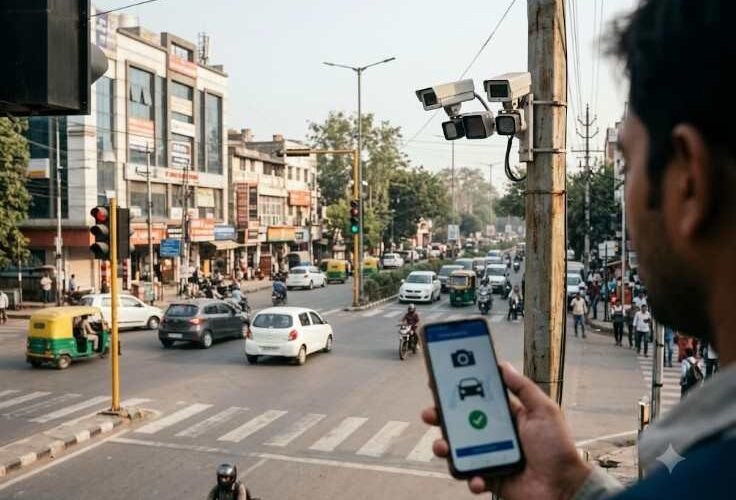
You drove through a junction on an ordinary day. No whistle, no officer waving you to the side, nothing that felt like trouble. Then, a few days later, your phone buzzes with a message about a traffic challan. It is natural to wonder how it happened.
The answer is a chain of cameras, databases and messages that works quietly in the background. Once you know how the chain works, challans stop feeling like surprises, and you can stay a step ahead of them.
The Camera That Never Blinks
Traffic police in many cities now watch the road through cameras that run day and night. Some read number plates automatically. Others measure speed, notice a vehicle crossing the stop line on a red signal, or record general footage from junctions and highways. Officers on the road also carry handheld devices that can log a violation on the spot with a photograph. In some cities, cameras can even spot a missing helmet or seat belt.
The most common catches are speeding, jumping signals, crossing the stop line, driving on the wrong side, using a phone while driving and parking where it is not allowed. Your vehicle does not have to be stopped for any of this to be recorded.
From a Flash to a Challan: What Happens in Between
Here is the usual journey.
- The camera captures the vehicle and reads its number plate.
- The picture and details travel to a control room server.
- In many cities, traffic staff look at the image to confirm that the violation is real.
- The system matches the number plate with the national vehicle database to find the registered owner and the mobile number linked to the vehicle.
- A challan is created with a number, the offence, the date, time and place, and the fine amount.
- A message goes out by SMS, and sometimes by email, to the registered owner.
The challan goes to the registered owner of the vehicle, whoever was driving at the time.
Why the Notice Reaches You Days Later
Every step above takes some time. Images wait in a queue for review, details are matched, and the challan is generated before any message is sent. That is why a violation on Monday may reach you on Thursday, or later.
Under the rules that came into force in January 2026, a challan has to be delivered within three days of being issued if it goes by electronic means, and within fifteen days if it is delivered by hand or other physical means. The time between the violation and the moment of issue can still differ from place to place.
Why Your Phone Number Decides Whether You Find Out
The message goes to the mobile number linked to your vehicle’s registration. If that number is old, switched off or belongs to a previous owner, the message never reaches you. The challan still exists, and its clock keeps running. The Ministry of Road Transport and Highways has urged owners to update their numbers for exactly this reason.
You can update the number online through the Parivahan website. The steps are simple.
- Open the mobile number update option for vehicles on the Parivahan website.
- Enter your registration number, chassis number, engine number and registration date from your RC.
- Add your Aadhaar details and the mobile number linked to your Aadhaar.
- Verify with the OTP and wait for the confirmation message.
The Clock That Starts the Moment a Challan Is Issued
For challans issued from 21 January 2026, the clock starts on the day the challan is issued, so every day your message goes unread uses up your time. You then have 45 days to either accept and pay the challan, or contest it on the official portal with documents that support your case.
If you accept, the amount has to be paid within the next 30 days. If you do nothing in the first 45 days, the challan is treated as accepted. Unpaid challans can also block vehicle and licence-related services. Older challans follow the earlier process, and states may add steps, so read the dates on your notice.
How to See a Challan Before the SMS Does
You do not have to wait for the message. You can check a vehicle by its number at any time on the government e-challan portal, and on platforms such as Cars24. Its challan check asks only for your vehicle number, needs no account, and pulls records from the central Parivahan database and from state sources. Some state systems update sooner than the national portal, so a challan can sometimes appear there first.
Violations from the last day or two can still take a little time to show up anywhere, so a second look after a couple of days is a good idea.
Habits That Keep Camera Challans From Surprising You
A few small habits make a big difference.
- Keep the mobile number on your registration active and up to date, and update it as soon as you buy a used car.
- Check your vehicle by number once a month, and after long trips, especially on highways and in other cities.
- Check after you lend your car to someone, since the challan reaches you as the owner.
- Save every message and note the date of issue, so you can count your 45 days.
- Pay or contest within the window and keep the receipt. If you pay through Cars24, you can follow the status in My Orders, and it can take up to 72 hours to show as paid.
Cameras never blink, but a correct phone number and a monthly check turn a surprise into a simple routine.